
The Promotion Nobody Asked For

This article is adapted from my latest book: The Human-Agent Orchestrator, about leading hybrid teams of humans and AI agents.
When was the last time a piece of software asked you what you wanted? Not a settings page. An actual question mid-task, waiting for your answer.
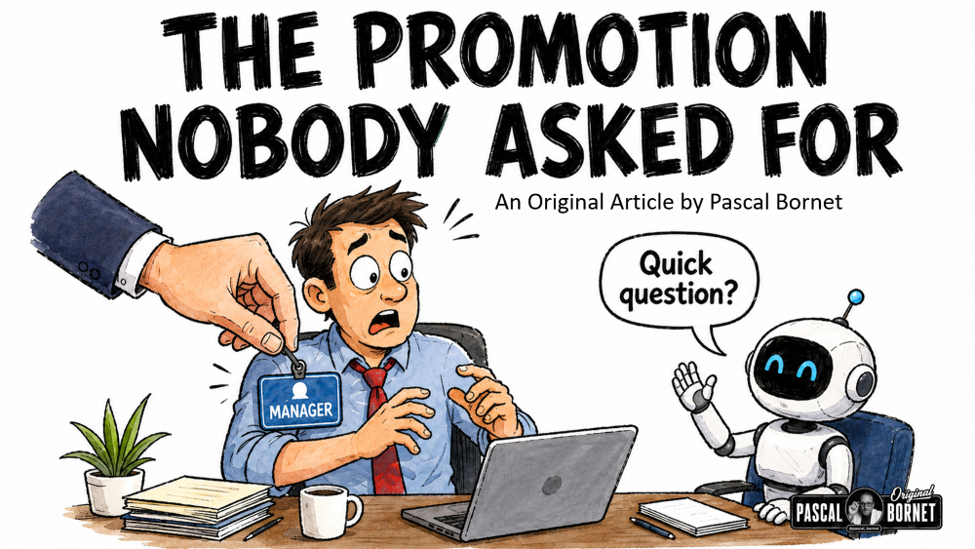
If you use agentic AI today, the answer is probably this week. “Who is your audience? What tone? Are you sure you want to send this?” Tools never did this before, because tools never needed to. The moment software starts reasoning and acting on your behalf, rather than simply executing instructions, working with it stops being a technical skill and becomes a management skill.
Which means, whether anyone told you or not, you have been promoted. No interview, no training, no raise. But you are now responsible for setting direction, evaluating judgment calls, and deciding what good looks like, for something that acts at a scale and speed no human report ever could.
This framing explains a pattern I could not otherwise account for. Why do some people thrive with agentic AI while more technically skilled people struggle? It is rarely prompting technique. It is almost always whether they already knew how to manage. People who had led human teams had already built the muscles: giving direction precisely enough to be useful, reviewing without micromanaging, calibrating trust over time. Those transfer. People who had only ever been individual contributors were suddenly asked to do something they had never practiced, with no warning the practice was now required.
This is where I want to push back on how most organizations train for AI. The dominant approach is technical: how to prompt, how the model works. Useful, but incomplete in a way I think will prove expensive. We are training people to operate a new tool while skipping the training for the new job that tool has quietly handed them.
Here is a claim I expect some readers will resist. I do not think the gap between organizations getting real value from AI and those getting marginal value is primarily a technology gap. I think it is a management gap, hiding in plain sight because we lack the language for the fact that management is what is actually being asked.
If that is right, the implication is uncomfortable. Being brilliant at your craft no longer guarantees you will be good with AI. What guarantees it, increasingly, is whether you can direct, evaluate, and build calibrated trust in something that works for you but is not you. That is learnable — but only once you recognize it as the actual skill in question, rather than the technical fluency everyone is currently focused on teaching.
So here is my real question. Do you think of yourself as managing your AI tools, or still as using them? I suspect that distinction predicts more about your results than any prompting course will.
If this resonated, the book goes deeper. We are celebrating two months since launch by dropping the e-book to $2.99 for a limited time. You can find it here: The Human-Agent Orchestrator. If you liked this article, I think you will find the rest genuinely useful.
#AgenticAI #Leadership #AIAdoption #FutureOfWork #Management #HumanAgentOrchestration