
The Supervision Trap: Why My Best Management Instincts Sabotaged My Own AI

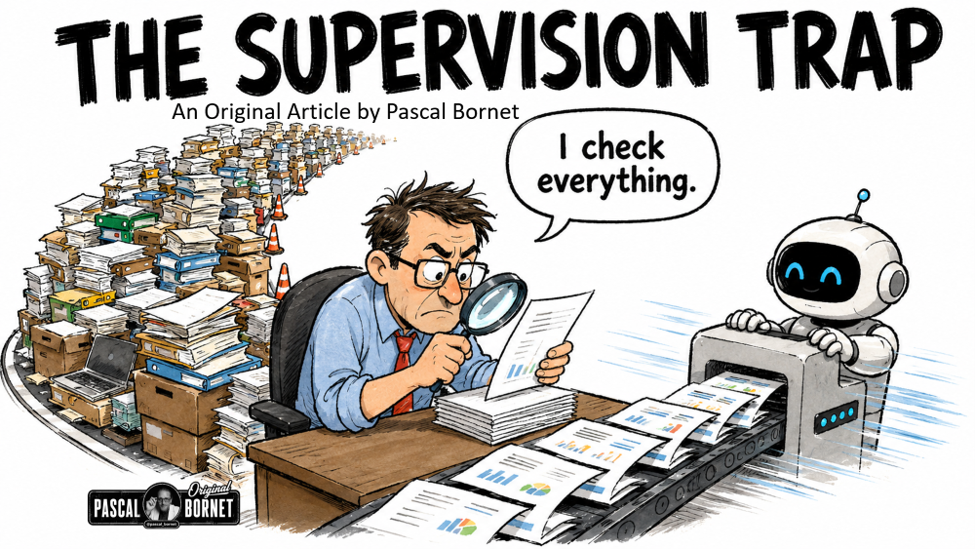
When we become the bottleneck in our own work.
This article is adapted from my latest book: The Human-Agent Orchestrator, about leading hybrid teams of humans and AI agents.
A question before you read further. If you left for a week starting tomorrow, would your AI-driven work keep moving without you, or quietly pile up waiting for your approval?
If it is the second, you do not have a system. You have an expensive tool that still needs a human hand on it constantly. And the reason is usually not carelessness. It is the opposite.
I have watched this pattern repeatedly. An agent makes a mistake. A responsible leader reviews more closely. The more they review, the more they find, because if you look hard enough at anything, you always will. Within weeks they are checking everything the agent produces. The agent runs at machine speed, the human at human speed, and the leader has become the bottleneck in their own system, by doing exactly what their career has trained them to do when something goes wrong.
This is the Supervision Trap, and it catches conscientious leaders first. Three forces drive it, none about AI itself. Identity: your career advanced because you caught the errors others missed, so stepping back feels like erasing the evidence of your competence. Loss aversion: a single bad output lands roughly twice as hard as a good one feels rewarding, so fifty clean results will not earn your trust, but one mistake will break it. And the illusion of control: your brain rewards the act of checking, even when the checking itself is what is slowing the system and making it worse.
Most conversations about AI adoption focus on capability. Is the model good enough, is the data clean enough. I think that conversation is increasingly beside the point. In most enterprise contexts the technology is ready. The manager is not, and unlike model capability, that does not improve with a better subscription.
Here is where I expect disagreement. I believe most leaders checking their AI systems obsessively are, without realizing it, optimizing for their own psychological comfort rather than the organization’s actual output. That is uncomfortable to hear, and it was uncomfortable to admit about myself, in a far more expensive way than I am asking of you.
The way out is not checking less and hoping for the best. It is building a system that does not require your constant presence, then trusting it in stages, with evidence rather than faith. That is a different skill from the one that got you promoted, and worth learning deliberately — the alternative is spending your career as the most expensive component in a system designed to run without you.
So I will ask again, more specifically. What are you checking this week not because it needs checking, but because checking it makes you feel like you are still doing your job? I suspect the answer is worth sitting with.
If this resonated, the book goes deeper. We are celebrating two months since launch by dropping the e-book to $2.99 for a limited time. You can find it here: The Human-Agent Orchestrator. If you liked this article, I think you will find the rest genuinely useful.
#AgenticAI #Leadership #AIStrategy #FutureOfWork #Management #HumanAgentOrchestration